We always discuss the role of technology in enhancing performance of athletes. However, technology can do more harm than good if there are no standardised performance testing protocols in place. While testing your clients to check progress, have you wondered:
- Why the tests show large differences in numbers?
- Why performance reduces despite doing everything right?
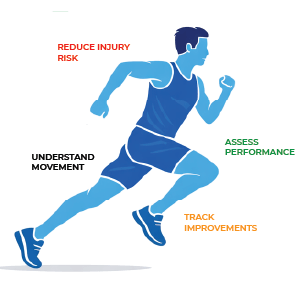
Clinical and sports practice relies on measurements to understand movement, assess performance, reduce injury risk, and track improvements. However, data is only meaningful if the collection procedure is consistent. Therefore, well-defined performance testing protocols and standardisation of tests and measurements become essential.
Without proper standardisation, even the most sophisticated tools can produce misleading results. In fact, small variations in performance testing protocols or testing conditions can lead to differences that have nothing to do with an athlete’s actual performance.
This blog explores why standardisation matters and which factors should always be controlled during testing, especially when implementing reliable performance testing protocols.
How to ensure standardisation
1. Timing of Testing should be consistent
The time of day when testing takes place can significantly influence results.
Human performance naturally fluctuates throughout the day due to circadian rhythms, fatigue levels, and prior activity. For example, strength, flexibility, and reaction times may vary between morning and evening.
If an athlete is tested at 8 AM one week and 6 PM the next, differences in results might reflect biological variability rather than actual improvement or decline.
Therefore, within performance testing protocols, controlling the timing of testing is very important.
Best practice:
Try to test individuals at the same time of day for each session.
2. Clothing and Footwear in Performance Testing Protocols
Clothing might seem like a minor detail, but in biomechanics it can influence results more than people expect.
Different clothing can affect:
- Range of motion (imagine running in denims vs shorts!)
- Movement patterns
- Sensor accuracy (for motion capture or wearable devices)
Similarly, footwear can alter ground reaction forces, joint angles, and stability. Hence it is important to test athletes in the same footwear that they use during the sports activity. Moreover, consistent clothing and footwear are important considerations when designing reliable performance testing protocols.
Best practice:
Ensure participants wear similar clothing and the same type of footwear during each testing session.
3. Testing Environment in Performance Testing Protocols
Environmental factors play a surprisingly large role in performance testing.
Changes in:
- Temperature
- Humidity
- Surface type
- Lighting
- Noise levels
can all influence results. For instance, muscle performance and flexibility are affected by temperature, while unstable surfaces can alter balance measurements.
Therefore, controlling the environment is a key component of well-designed performance testing protocols.
Best practice:
Maintain a consistent testing environment as much as possible.
4. Duration and Structure of Performance Testing Protocols
Testing protocols should always follow a consistent structure.
Differences in:
- Warm-up duration
- Rest intervals
- Test order
- Total session length
can influence fatigue levels and ultimately affect results.
For example, if someone performs a strength test after a fatiguing agility drill in one session but before it in another, the results won’t be comparable.
Therefore, clearly structured performance testing protocols are essential to minimise fatigue-related variability.
Best practice:
Use a standardised protocol that outlines the exact order and timing of every test.
5. Tester Knowledge and Skill in Performance Testing Protocols
Even with clear protocols, the tester’s expertise can influence results.
An experienced tester knows:
- How to give consistent instructions
- How to identify errors in movement
- When a trial should be repeated
- How to position equipment correctly and consistently
Inexperienced testers may unintentionally introduce variability through inconsistent instructions or measurement techniques. Therefore, proper training of testers is an important part of implementing reliable performance testing protocols.
Best practice:
Ensure testers are properly trained and familiar with the protocol.
6. Using the Same Tester reduces variability
Whenever possible, the same tester should conduct repeated measurements. This reduces inter-tester variability, which occurs when different testers measure the same variable slightly differently.
Even small differences in marker placement, measuring technique, or instruction style can influence outcomes. Thus, using the same tester helps maintain consistency within performance testing protocols.
Best practice:
Assign one primary tester for repeated assessments whenever possible. Further, use a marker placement guide to standardise marker placement locations.
7. Clear Instructions to Participants reduces confusion
Participants should always receive the same instructions before each test. Variations in explanation, encouragement, or demonstration can influence motivation and effort.
Standardised instructions ensure that each participant understands exactly what is expected. Similarly, consistent instructions are a key component of structured performance testing protocols.
Best practice:
Use scripted instructions when conducting tests.
Why Standardisation improves results: Part 1
Standardisation helps ensure that differences in results reflect true physiological changes, not testing inconsistencies.
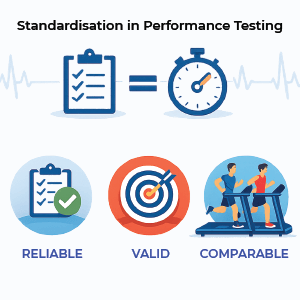
When testing conditions are controlled, we improve:
- Reliability – the test produces consistent results
- Validity – the test measures what it is supposed to measure
- Comparability – results can be compared across sessions or individuals
Therefore, strong standardisation significantly improves the reliability of performance testing protocols.
For biomechanists, coaches, clinicians, and researchers, this leads to more trustworthy insights and better decision-making
Why Standardisation improves results: Part 2
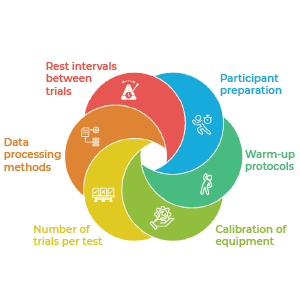
Beyond the factors mentioned above, a few additional elements can further improve testing consistency:
- Participant preparation (sleep, caffeine, previous training)
- Warm-up protocols
- Calibration of equipment
- Number of trials per test
- Data processing methods
- Rest intervals between trials
These details may seem small individually, but together they contribute to the overall reliability of biomechanical measurements and improve the quality of performance testing protocols.
Overall, keeping these factors in mind not only produces better data, it also leads to accurate decisions for the client. Ultimately, well-designed performance testing protocols allow clinicians and coaches to interpret results with greater confidence.
Let us know in the comments which practices you follow!
At GaitON, we believe in developing systems for biomechanical analysis which are highly standardised. Further we ensure thorough training to ensure accurate data collection for all the assessments. To book a demo, contact us today!
ABOUT THE AUTHOR

GAYATRI SURESH (PT)
Gayatri Suresh (PT) is a Biomechanist who has completed her B.P.Th from DES College of Physiotherapy and M.P.T (Biomechanics) from SRM College of Physiotherapy, SRMIST. Her field of clinical expertise is in movement assessments through video analysis. Apart from her work at Auptimo, she works as a Clinical Specialist at Rehabilitation Research and Device Development, IIT Madras. She has won gold medals for her Research presentations and for securing First rank with distinction in her MPT degree respectively.