While researching the content to write in this blog, I had a chance to speak to some physiotherapists to understand their thoughts on the feasibility of ‘Biomechanical Analysis in Physiotherapy’. Here are some of their comments:
“I already assess muscle strength manually. Why do I need a dynamometer?”
“If I have measured quadriceps strength with a dynamometer, why should I also perform a Countermovement Jump?”
“Can’t we identify most problems during a good physical examination itself?”
“All this equipment are just fancy bro. Nothing they do. They just show some extra numbers to attract the patient”.
As I was about to argue, I paused for a moment to understand things from their perspective. It is true that physiotherapy has long worked without the use of expensive equipment. And now while these equipment have become more accessible, has their importance, apart from adding extra data, really been taught?
Physiotherapists are trained extensively in observation, palpation, range of motion assessment, muscle testing, special tests and functional examination. A good clinical examination can tell a lot about a patient.
So arises the question;
Does biomechanical biomechanical analysis in physiotherapy actually give additional information, or is the technology simply being used to measure something that is already known through clinical examination?
Being a biomechanist, I would argue that it depends on the problem we are trying to solve.
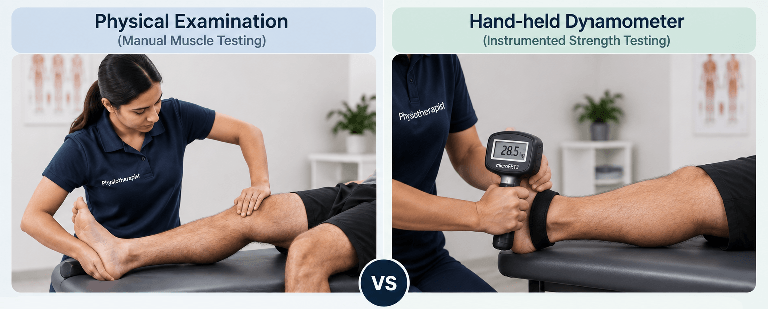
Clinical examination and biomechanical analysis in physiotherapy answer different questions
Consider a patient following ACL reconstruction.
A clinical examination assesses the following –
- Knee range of motion
- Quadriceps strength
- Hamstring strength
- Pain
- Swelling
- Joint stability
- Single-leg balance
- Functional ability
Suppose the patient has nearly full range of motion, minimal pain and good quadriceps strength on dynamometry.
Does that automatically mean the person is ready to run, jump or return to sport?
Not necessarily.
The patient may still:
- Offload the operated limb during landing
- Produce less force through that limb
- Take longer to generate force
- Land with altered knee or hip mechanics
- Shift more load to the opposite limb
- Demonstrate poor control during deceleration
Many of these changes may not appear during an isolated strength test.
This is where biomechanical analysis in physiotherapy becomes useful.
It allows to move from asking:
“How strong is this muscle?” To: “How is this strength being used during movement?”
Choosing the correct biomechanical analysis in physiotherapy practice
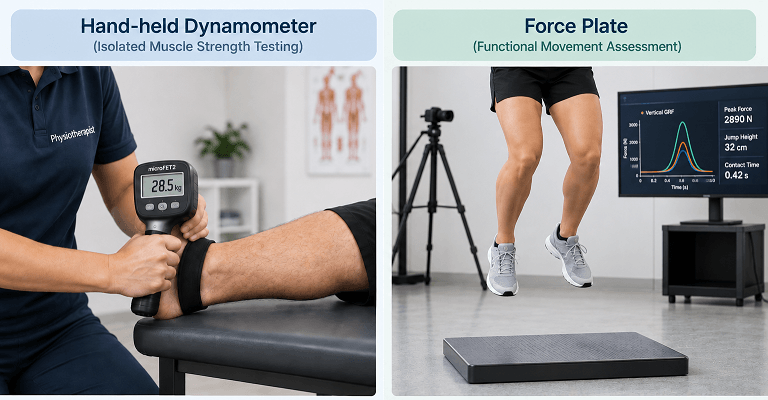
“If I have a dynamometer, why do I need a force plate?”
A question I often get asked is, “Do I really need all the tech”? . Well, not really. Depends on what one does at their centre. However, certain technologies are not replacements for each other.
A dynamometer and a force plate for example, are not competing technologies. They measure different components of performance. A dynamometer may tell us how much force a particular muscle group can produce under a specific testing condition.
For example,
Right quadriceps strength = 30 kg
Left quadriceps strength = 28 kg
The strength difference may appear relatively small.
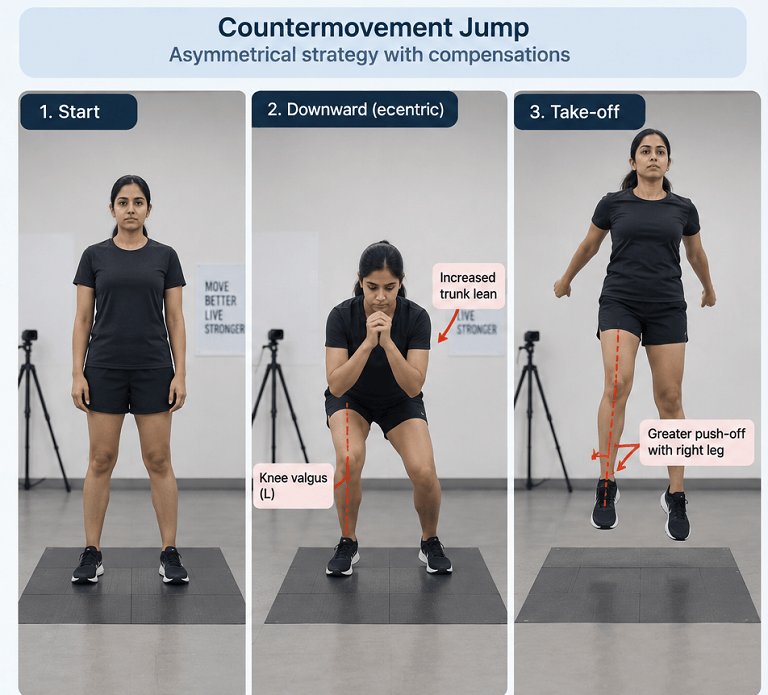
But now ask the same person to perform a Countermovement Jump on a force plate. During the jump, the person has to rapidly coordinate the ankle, knee and hip while producing force against the ground.
We may find that the person:
- Produces less force through the left leg
- Develops force more slowly
- Uses a different countermovement strategy
- Shifts the centre of pressure towards the right
- Has reduced jump height
- Shows greater asymmetry during the braking or propulsive phase
Nothing changed in the person.
The task changed.
An isolated strength assessment tells us about force-producing capacity. A jump assessment tells us how multiple joints and muscles coordinate that capacity during a rapid functional task. Both pieces of information are useful in decision making.
What does EMG add?
The same principle applies to electromyography. During examination, we may know that a muscle is strong enough to perform a task. But strength does not tell us:
- When is the muscle active?
- How long is it active?
- Is the timing appropriate for the movement?
- Are other muscles compensating?
Consider someone with altered scapular movement. Manual muscle testing may indicate adequate strength in the serratus anterior and trapezius. But during arm elevation, EMG may reveal changes in muscle recruitment or activation timing.
Again, the question has changed.
Biomechanical analysis in physiotherapy is essentially about relationships
This, in my opinion, is one of the most useful ways to understand biomechanics. Physical examination often assesses individual components.
We assess:
- Strength
- Range
- Flexibility
- Balance
- Pain
- Joint mobility
But human movement is produced by all these components interacting simultaneously. Biomechanics examines these relationships. For example: A runner with knee pain may have normal knee strength. But during running, the person may demonstrate increased hip adduction, altered cadence and a particular loading strategy. Another runner with exactly the same diagnosis may demonstrate completely different mechanics.
Biomechanical assessment therefore helps us understand how the individual performs the activity that is actually relevant to their problem.
But can’t we identify all of this clinically?
Sometimes, yes. Sometimes, no. And this is important.
Not every patient needs sophisticated biomechanical testing.
If the clinical examination already provides enough information to make a treatment decision, additional testing may not change management. Technology should not be used simply because it is available. The value of an assessment depends on whether it answers a clinically relevant question.
For example: If a patient with acute ankle sprain has pain, swelling and difficulty weight bearing, a force plate assessment may contribute very little during the initial consultation.
On the other hand, six months later, the same patient may have:
- Full range
- Minimal pain
- Good strength
- Normal walking
but still feel unstable while jumping, landing or changing direction.
Now a biomechanical assessment may reveal something that routine clinical examination does not.
Biomechanical analysis allow quantification in physiotherapy practice
There is another problem with relying entirely on observation. Consider statements such as:
“The patient is putting slightly less weight on the left.”
“The knee collapses inward a little during landing.”
“The gait looks better than last month.”
These observations may be clinically useful.
But how much less weight? How much knee movement? How much improvement?
Biomechanical assessments allow us to convert observations into measurable variables.
Biomechanics can also reveal compensations
One of the most interesting things about the human body is its ability to compensate. And this is something I see in most patients cleared from physiotherapy
If one structure cannot perform a task efficiently, another structure often takes over. And the person may still complete the movement successfully. This means that simply observing whether a person can perform an activity may not tell us how they are performing it.
- A patient may successfully complete a squat while:
- Shifting weight towards one side
- Increasing trunk lean
- Reducing ankle dorsiflexion
- Using greater hip contribution
- A patient may walk independently while still unloading one limb.
- An athlete may return to jumping while relying excessively on the uninvolved limb.
Where can biomechanical analysis add value in physiotherapy practice?
In clinical practice, their relevance may broadly include:
- Quantifying movement abnormalities: Instead of describing a movement as excessive or reduced, it can be objectively measured.
- Identifying compensatory strategies: The primary impairment may be at one joint while the visible compensation appears elsewhere.
- Assessing movement under functional load: Some deficits appear only during walking, running, jumping, landing or sport-specific activities.
- Monitoring rehabilitation: Repeating the same assessment can help determine whether movement or loading strategies have changed.
- Return-to-sport decision-making: Strength and recovery alone may not necessarily indicate restoration of movement performance.
- Understanding asymmetry: Force plates, dynamometry and movement analysis can help determine how differently the two limbs are being used.
- Providing visual feedback: Showing patients how they move can improve their understanding of rehabilitation goals.
- Supporting clinical reasoning: Biomechanical data can provide additional information when symptoms, strength and movement ability do not appear to match.
Important note – Biomechanical assessment should not replace clinical examination
GaitON offers Biomechanical solutions for physiotherapists to integrate in everyday practice. The tech is designed to assist clinical examinations and better reach a diagnosis. To book a demo, contact us today!
ABOUT THE AUTHOR

GAYATRI SURESH (PT)
Gayatri Suresh (PT) is a Biomechanist who has completed her B.P.Th from DES College of Physiotherapy and M.P.T (Biomechanics) from SRM College of Physiotherapy, SRMIST. Her field of clinical expertise is in movement assessments through video analysis. Apart from her work at Auptimo, she works as a Clinical Specialist at Rehabilitation Research and Device Development, IIT Madras. She has won gold medals for her Research presentations and for securing First rank with distinction in her MPT degree respectively.
The information found within this site is for general information only and should not be treated as a substitute for professional advice from a licensed medical practitioner. Any application of exercises and diagnostic tests suggested is at the reader’s sole discretion and risk.